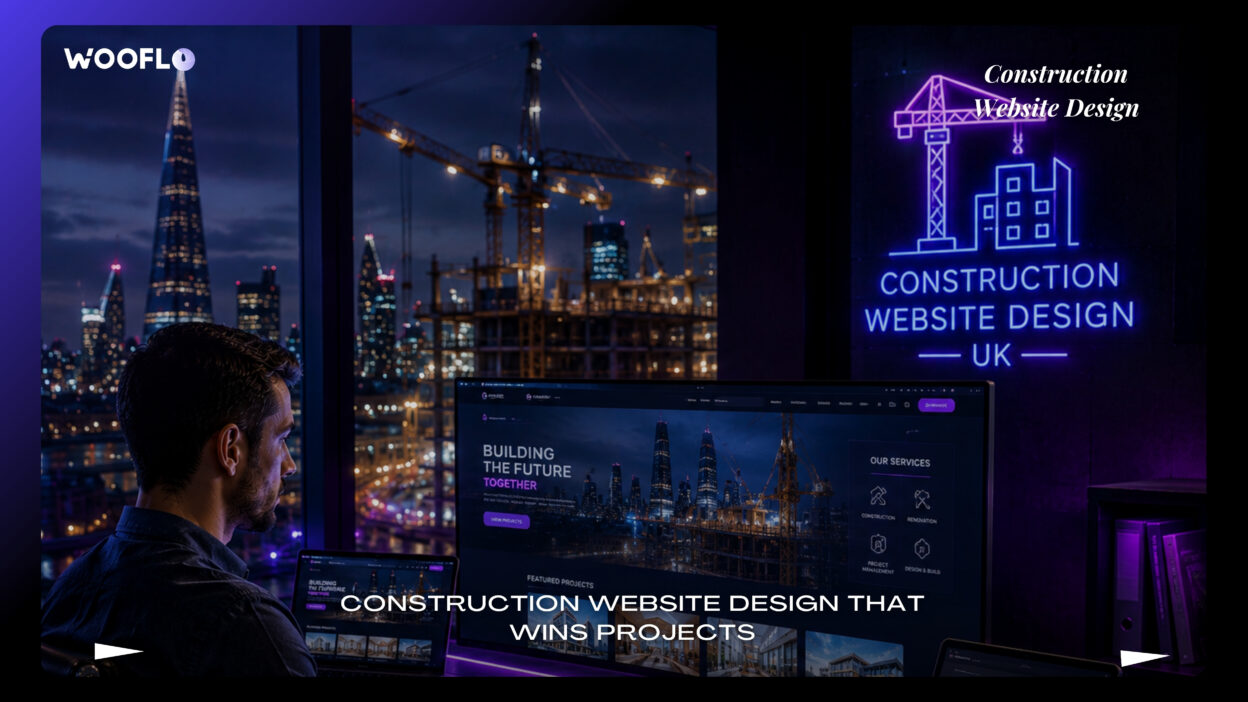
Every construction business owner knows the feeling. You do brilliant work on-site, yet the phone stays quiet. Construction website design is the most overlooked growth lever in the industry — and the gap between builders winning projects online and those losing them to competitors comes down to one thing: whether your website is a passive brochure or an active sales system.
This guide gives you everything: what works, what doesn’t, and exactly how to turn your construction website into a machine that fills your calendar with qualified project enquiries.
Why Construction Companies Are Losing Leads Online
The UK construction industry is worth over £110 billion. Yet thousands of builders, contractors, and construction firms are invisible online — handing warm leads directly to competitors every single day.
Your Website Is Your #1 Sales Tool — Is It Working?
Before a client ever picks up the phone, they’ve already judged you. Research shows that a poorly designed website drives visitors away within seconds — and in construction, a slow, outdated, or hard-to-navigate site signals poor attention to detail before you’ve even quoted. Your website design and development services need to work as hard as your site team does.
The Costly Mistake Most Builders Make Online
Most construction companies still treat their website as a one-time job — built once, forgotten for years. That’s the single biggest mistake. Digital marketing is not a one-off cost; it’s a continuous investment that compounds. A website built in 2019 with no updates, no SEO, and no lead capture is actively costing you business every month it sits unchanged.
What 75% of Clients Do Before Calling a Contractor
The buyer journey has shifted permanently. 75% of new clients now expect a seamless digital experience before they’ll trust a builder with their project — and 63% of property buyers say online research is their starting point. If your website doesn’t answer their questions, showcase your best work, and make it effortless to get in touch, they’ll find someone whose site does.
What Makes a Good Construction Website Design
A high-performing construction website isn’t just visually impressive — it’s strategically built to guide visitors from first impression to firm enquiry. Here’s what separates the best from the rest.
Mobile-First Design for Construction Companies
92% of construction website traffic now comes from mobile devices. If your site isn’t fast, clean, and fully functional on a smartphone, you’re losing nearly every visitor before they see your first project photo. Mobile-first construction website design means tap-friendly buttons, click-to-call functionality, and pages that load in under three seconds on any connection.
Fast Loading Speed and Core Web Vitals
Google uses Core Web Vitals — including page speed, visual stability, and responsiveness — as direct ranking signals. A reasonable target for a construction homepage is under 1.5MB total transfer, with the Largest Contentful Paint under 2.5 seconds. Slow sites don’t just lose visitors — they lose rankings too.
Clear Project Portfolio and Before/After Galleries
In construction, your work speaks louder than any copywriter ever could. A well-structured project portfolio — with high-quality images, project descriptions, client names, and completion dates — builds instant credibility. Organise work by sector (residential, commercial, civil) so visitors immediately see relevant examples for their own project type.
Trust Signals: Reviews, Certifications, and Testimonials
Social proof is non-negotiable in construction. Prominently display Google reviews, industry accreditations (NHBC, FMB, CHAS), insurance badges, and named client testimonials. Use your reputation management system to keep these fresh and current — stale reviews from 2021 raise more questions than they answer.
Strong Calls-to-Action That Convert Visitors to Enquiries
Every page of your construction website should have a single, clear next step. “Get a Free Quote,” “Book a Site Visit,” or “Call Us Now” — one primary action, placed above the fold and repeated at the bottom of every page. The fewer clicks between a visitor and a conversation with your team, the more enquiries you capture.
Construction Website Design vs. a Construction Growth System
Here’s what no web design agency will tell you: a website alone doesn’t win projects. What wins projects is a complete digital growth system — and construction website design is just the starting point.
Why a Pretty Website With No Leads Is a Ferrari With No Fuel
You can spend £5,000 on a beautifully designed construction website. But if it has no SEO foundation, no local search visibility, no review strategy, and no lead nurturing — it’s a showroom car with an empty tank. It looks impressive. It goes nowhere. The construction companies winning online aren’t just the ones with the best-looking sites; they’re the ones whose sites are connected to a fully integrated digital marketing ecosystem.
How AI Tools Transform Your Construction Website Into a Lead Machine
Modern construction website design now integrates AI solutions that would have cost enterprise-level budgets just five years ago. Think:
- AI chatbots that qualify leads at 2am when your team is off-site
- AI voice agents that answer missed calls, capture project details, and book consultations automatically
- Automated follow-up sequences that nurture enquiries who didn’t convert immediately
- AI-powered content tools that keep your site fresh with minimal effort
These aren’t gimmicks — they’re the difference between a website that generates leads while you sleep and one that only works when you do.
Reputation Management: The Missing Piece in Construction Website Design
Your website can look world-class, but if a potential client Googles your business name and finds three outdated reviews and a 3.8-star rating, the enquiry dies before it starts. Reputation management — systematically collecting 5-star Google reviews after every completed project — is the most underleveraged growth tool in construction. Wooflo’s NFC review tap-cards make this effortless: your team member taps the card to a client’s phone at project completion, and the Google review page opens instantly.
From Website Launch to Consistent Project Enquiries — The Full Picture
| Stage | What Happens | Tools Required |
| Launch | Website goes live with on-page SEO | Design + copywriting + technical SEO |
| Visibility | Site ranks for local construction searches | Local SEO + GMB optimisation |
| Trust | Visitors see reviews, portfolio, accreditations | Reputation management + social proof |
| Capture | Enquiry forms, AI chat, click-to-call convert visitors | AI chatbots + lead forms |
| Nurture | Non-converters get followed up automatically | Email automation + AI voice agents |
| Growth | More enquiries, better quality, repeat clients | Ongoing SEO + Google Ads |
Key Features Every Construction Website Must Have
Based on analysis of 13 construction website features that generate leads, the best-performing construction websites share a consistent set of technical and strategic elements.
SEO for Construction Companies: Ranking Where Your Clients Search
Your construction website design means nothing if it sits on page 4 of Google. On-page SEO — properly structured headings, keyword-rich service pages, fast page speeds, and schema markup — is the foundation of sustainable lead generation. Use Wooflo’s free SEO tools to run an instant analysis of your current website performance. For a deeper dive, our guide to SEO for construction companies covers the full technical playbook.
Local SEO: Dominating “Builders Near Me” Searches
“Builders near me,” “construction company [city],” and “contractors in [area]” — these are the searches that turn into project enquiries. Local SEO for construction means:
- A fully optimised Google Business Profile with photos, reviews, and service areas
- Location-specific pages for every area you serve
- Consistent NAP (Name, Address, Phone) citations across all directories
- Regular posts and updates to your Google Business Profile
Use the Wooflo GMB audit tool to identify every gap in your current local presence.
Project Portfolio Design: Showcasing Work That Sells
Every project page should function as a standalone case study: the brief, the challenge, the solution, the result. Include high-resolution photography, the client’s sector, project value range (where appropriate), and completion timeline. This structure also creates powerful SEO content — each project page can rank for location + project type searches.
Lead Capture Systems: Forms, Click-to-Call, and Live Chat
Every construction website needs at least three ways to get in touch:
- A short, friction-free enquiry form (name, project type, location, phone number — nothing more)
- A prominent click-to-call button visible on every mobile page
- A live chat or AI chatbot for out-of-hours enquiry capture
Test your forms regularly. A broken contact form is the most common and most damaging issue on construction websites — and most business owners don’t find out for weeks.
Google Business Profile Integration
Your Google Business Profile is essentially a second website — and for local searches, it often appears before your actual site. Link it directly from your website, embed your Google reviews, and ensure your address, phone number, and opening hours match exactly across both. Inconsistency here damages your local SEO rankings.
Website Security, Maintenance, and Ongoing Support
An SSL certificate, regular software updates, daily backups, and uptime monitoring are non-negotiables — not optional extras. A hacked or downed construction website costs you every enquiry that lands during the outage. Build maintenance into your investment from day one.
Construction Website Design for Every Type of Business
The best construction website design is never one-size-fits-all. Different business sizes, specialisms, and audiences need fundamentally different approaches.
Website Design for Sole Trader Builders
For a sole trader, the website needs to do one thing brilliantly: build personal trust fast. A professional headshot, a clear “About Me” section that explains your background and values, a focused portfolio of your ten best jobs, and a simple single-page enquiry form. Keep it lean. Keep it honest. Keep it fast. See our guide on small business website design to avoid the most common budget mistakes.
Website Design for Local and Regional Contractors
A local contractor serving a 30-mile radius needs location-specific SEO baked into every page. Separate service area pages for each town or city, a Google Business Profile integration, and a reviews strategy that keeps your star rating above 4.5 are the three pillars. Local SEO is not a nice-to-have at this level — it’s the primary growth engine.
Website Design for Large Construction Firms
A large firm needs a construction website that functions as a corporate brand asset. Multi-department service pages, a substantial project portfolio with filter by sector, dedicated team and leadership pages, investor and press sections, and a full content marketing strategy. At this level, the website is the centrepiece of a broader digital marketing strategy.
Website Design for Specialist Sectors: Roofing, Electrical, and Beyond
Specialist contractors — roofers, electricians, scaffolders, cladding specialists — need hyper-targeted construction website design that speaks directly to their niche. Generic builder websites don’t rank for specialist search terms. Build dedicated service pages for each specialism, optimise for sector-specific queries, and use imagery that reflects exactly what you do. Our SEO for electricians and SEO for roofers guides go deep on sector-specific tactics.
How Much Does Construction Website Design Cost?
One of the most-searched questions in the industry — and one where most agencies deliberately stay vague. Here’s an honest breakdown.
Starter Construction Websites: What to Expect
A basic construction website — five to eight pages, mobile responsive, with a portfolio section and contact form — typically costs between £1,500 and £4,000. At this level, you get a credible online presence. What you don’t get is SEO, lead capture systems, ongoing support, or any integration with your marketing strategy. Use our ROI calculator to model what a website at this investment level could return.
Full Business Construction Websites: Investment vs. Return
A fully built, SEO-optimised construction website with AI integrations, reputation management, local search visibility, and ongoing support is an investment of £3,500 to £10,000+ depending on the size of the firm and scope of services. But framed correctly, the question isn’t “how much does it cost?” — it’s “how many additional projects does it need to generate to pay for itself?” For most construction firms, the answer is one or two jobs. See our website creation pricing page for transparent package details.
What You Should Demand for Your Money
Before signing anything, your construction website design agency should guarantee:
- Mobile-first, responsive design tested on real devices
- On-page SEO included from day one — not an add-on
- Clear ownership of your domain and website files
- Ongoing support with defined response times
- Measurable outcomes — not just a finished site, but a plan for leads
Check Wooflo’s guarantee page to see exactly what we stand behind.
How to Choose the Right Construction Website Design Agency
The construction web design market is full of generalist agencies who’ve added a construction page to their portfolio. Here’s how to separate the real specialists from the rest.
Questions to Ask Before Hiring a Web Design Agency
Before committing to any agency, ask these directly:
- Can you show me construction websites you’ve built — and their Google rankings?
- Does your package include SEO, or is that a separate cost?
- Who owns the website when it’s built — me or you?
- What ongoing support do you provide after launch?
- Do you have experience with CRM and project management integrations?
If an agency can’t answer these confidently, keep looking.
Red Flags: What Cowboy Agencies Won’t Tell You
- “SEO is included” — but they mean five keywords and a meta description
- No portfolio of ranking, lead-generating sites — only screenshots of how they look
- You don’t own your domain — locked into their hosting with no exit clause
- No analytics or reporting — you have no way to measure what you’re getting
- One-size-fits-all templates presented as “custom design”
Check client reviews before committing to any agency. Real testimonials from named clients in verifiable sectors are the gold standard.
Why a Growth Partner Beats a One-Time Web Designer
A web designer builds your site and moves on. A growth partner — like Wooflo — builds your site, optimises it for search, manages your reputation, runs your Google Ads, and measures every outcome against agreed targets. See the difference in action through our case studies.
| One-Time Web Designer | Wooflo Growth Partner |
| Builds the website, then leaves | Builds + manages + optimises continuously |
| No SEO strategy | Full local + on-page SEO built in |
| No review or reputation management | Systematic 5-star review generation |
| No lead tracking or analytics | Full ROI reporting and ROI calculator |
| No AI tools or automation | AI chatbots, voice agents, automation workflows |
| No guarantee | Results guaranteed |
Why Wooflo Delivers More Than Construction Website Design
Wooflo isn’t a website agency that happens to serve construction businesses. We’re a full-stack digital growth partner built specifically to help trade and construction businesses generate consistent, high-quality project enquiries — month after month.
AI-Powered Reputation Management Built Into Your Website Strategy
Every Wooflo construction website is connected to a live reputation management system. We don’t just build your website and hope reviews appear — we build automated workflows that systematically collect 5-star Google reviews after every completed project. More reviews mean higher local search rankings, more trust on your website, and more enquiries from clients who’ve already decided to trust you before they’ve called.
NFC Review Tools That Collect 5-Star Reviews on Every Job
Wooflo’s physical NFC tap-cards are one of our most popular tools for construction businesses. Leave the card with your client at project completion. They tap it with their phone. The Google review page opens instantly. No app, no login, no friction. Clients who would never find the time to leave a review on their own do it in seconds. It’s the simplest way to build a five-star reputation at scale.
Guaranteed Results — We Work Until We Deliver
We put our results where our mouth is. Our guarantee is simple: if we don’t deliver on the agreed outcomes, we keep working — at no extra cost — until we do. No agency that builds a website and disappears can offer that. It’s not a contract; it’s a partnership.
Your Dedicated Growth Partner for the Construction Industry
Whether you’re a sole trader looking for your first professional online presence or a regional contractor ready to scale into new territories, Wooflo has the tools, the team, and the track record. Book a free 30-minute strategy call and we’ll show you exactly what’s holding your current website back — and what it would take to fix it.
Frequently Asked Questions About Construction Website Design
What should a construction company website include?
A high-performing construction website should include a clear homepage with a strong headline and call-to-action, a detailed services page, a project portfolio with real photography, an About Us page with team information and accreditations, a prominent contact page with a form and click-to-call, Google reviews integration, and on-page SEO throughout.
How long does it take to build a construction website?
A professional construction website typically takes 4 to 8 weeks from briefing to launch, depending on the complexity of the project, the number of pages, and how quickly the client provides content. An ongoing SEO and lead generation campaign alongside the website build adds several weeks to initial planning but dramatically improves long-term performance.
Will a new website help me win more construction jobs?
Yes — provided it’s built with lead generation in mind. A website that is mobile-responsive, SEO-optimised, connected to your Google Business Profile, and equipped with strong calls-to-action and trust signals can significantly increase both the volume and quality of project enquiries. Use our ROI calculator to model expected returns before committing.
How important is mobile design for construction websites?
Critical. With 92% of construction website traffic now arriving via mobile devices, a site that isn’t fully optimised for smartphones will fail regardless of how it looks on desktop. Mobile-first design, fast load speeds, and tap-friendly navigation are non-negotiable fundamentals of any construction website design brief in 2026.
What is the difference between a website and a lead generation system?
A website is a digital brochure — it shows who you are and what you do. A lead generation system is a website plus SEO, plus reputation management, plus AI tools, plus Google Ads, plus ongoing optimisation — all working together to bring in enquiries continuously. Wooflo builds lead generation systems, not just websites. Explore our full suite of AI solutions to see what’s possible.
How do I get more Google reviews for my construction business?
The most effective method is to ask immediately after project completion — when client satisfaction is highest. Wooflo’s NFC tap-cards remove all friction from the process, opening the Google review page with a single tap. Combined with automated email marketing follow-up sequences, this creates a consistent review collection system that works even when you’re too busy to think about it.
Ready to build a construction website that actually wins projects? Book your free 30-minute strategy call with the Wooflo team today — and find out exactly what your current website is costing you.
Contact Information:
- Email: info@wooflo.pro
- Website: https://wooflo.com/
- Google Maps: https://maps.app.goo.gl/pydw8rU9gncWBwCS6
- Google Link: https://share.google/tqL92yxlIrgPVjGdh
- Contact Number: +33 7 45 96 94 59